
Oaks Prison Release Paths
Oaks Correctional Facility is an adult-male Level II and IV state prison operated by the Michigan Department of Corrections. It is not the county jail. People housed there serve MDOC sentences, and the Michigan Parole Board holds parole authority for eligible state prisoners. A person may leave Oaks on parole, reach discharge, or transfer to another MDOC institution. The facility field alone does not tell which event occurred.
Parole is conditional release from the prison sentence to community supervision. Discharge generally means the sentence or relevant supervision has ended. A transfer remains custody, even when Oaks no longer appears as the current location. Oaks is not identified on its official page as an MDOC release center, so departure from this prison can be an internal MDOC move before any parole or discharge. Read status, dates, facility, and supervision location together.
A changed Oaks assignment is not proof of release. OTIS status and Date Paroled or discharge information provide the stronger state-system signal.
Confirm Oaks Prison Release
The Offender Tracking Information System, known as OTIS, is MDOC’s public lookup. Search by MDOC number when available because it is more precise than a name. Otherwise use the displayed name fields, then compare birth year, convictions, court, county, and other identifiers. Open the correct profile and preserve the labels exactly as shown.
- Search OTIS by MDOC number or name and match more than one identifier.
- Read the current status and facility field. Another prison assignment means transfer, not release.
- Record Date Paroled, supervision location, Earliest Release Date, Maximum Discharge, and any Projected Release Date shown.
- Use the sentencing court for errors drawn from the judgment and the supervising office for parole or absconder concerns.
- Request MDOC records if the profile is absent or the visible fields do not document the needed event.
OTIS includes people currently under MDOC jurisdiction and many who were discharged within the last three years. Public display ordinarily ends three years after discharge from supervision. An older no-match does not prove there was no MDOC record. A set-aside may also remove information from public display. The Manistee County released inmates lookup explains how to separate county, state, and federal systems when the custody owner is uncertain.
Note: Preserve the date checked because OTIS location, status, and projected dates can lag the underlying agency record.
Oaks Release Search Fields
An OTIS profile can provide a structured state record, but each label answers a different question. Status describes the public state-system condition. Date Paroled can identify the start of parole. Earliest Release Date is a point at which the Parole Board may gain jurisdiction, not a promise that the person will walk out. Maximum Discharge is the outside sentence endpoint under the controlling calculation. A Projected Release Date, when shown, is still subject to later events and correction.
| OTIS field | What it can show | What it cannot prove alone |
|---|---|---|
| Status | Current MDOC status label | The complete status of every other custody system |
| Facility | Current or recorded MDOC placement | That leaving Oaks was community release |
| Date Paroled | Recorded parole start | That supervision has ended |
| Earliest Release Date | Board eligibility or jurisdiction point | A guaranteed physical release day |
| Maximum Discharge | Outside sentence endpoint in the calculation | That parole will wait until that date |
| Projected Release Date | A current projection when present | An unchangeable gate date |
OTIS is limited to the Michigan state correctional system. It does not function as a Manistee County Jail roster, a BOP locator, or an ICE detainee search. If another authority takes custody after MDOC, a state release label must not be expanded into a claim that all confinement ended.
Oaks Prison Release Records
When OTIS is incomplete or the profile is outside its public display window, use the official MDOC FOIA process. Identify the person by full name, date of birth, MDOC number, and a useful date range. Name the records sought, such as the Basic Information Sheet, parole or release-status record, discharge certificate or order, and offender photograph. Asking for distinct records is more precise than requesting a general file package.
MDOC states that a certified PENPACK may include sensitive materials and is restricted to recognized criminal-justice authorities for official business. A public requester should not demand that package as if it were a routine public product. Ask for individually identified public records and accept lawful redaction. Fees are based on permitted work rather than a flat amount, so request electronic copies and an itemized estimate.
MDOC FOIA Coordinator
P.O. Box 30003
Lansing, MI 48909
MDOC-FOIA@michigan.gov
517-335-4194
Fax: 517-335-4193
MDOC also lists Corr_Records_Info@michigan.gov for current prisoners and MDOC-Records_Retention@michigan.gov for past-prisoner records up to six years after release. That service description does not mean all records are destroyed at six years. It also differs from the three-year OTIS public-display period.
Oaks Prison Contact
The facility contact can help identify Oaks and route a facility question, while OTIS and MDOC records remain the release-verification channels. Do not ask Manistee County Sheriff staff to certify an Oaks parole or discharge. The Sheriff does not own the state prison record. Likewise, Oaks should not be treated as the source for an unrelated county jail movement.
Oaks Correctional Facility
1500 Caberfae Highway
Manistee, MI 49660
231-723-8272
mdoc-oaks-public@michigan.gov
For a parole or felony-probation office, first read the supervision location on the correct OTIS profile. Manistee’s state parole and probation office is listed at 415 Third Street with telephone 231-723-7215, but assignments may follow a different county or interstate arrangement. The profile, not geography alone, should drive the contact.
Note: A facility email is not a substitute for the statewide offender record or a formal MDOC records request.
Oaks Prison Facility Facts
The official MDOC Oaks page describes an adult-male prison opened in 1992. It has seven prisoner housing buildings, Levels II and IV security, specialized START alternative-to-segregation units, and a stated capacity of 1,108. MDOC reports approximately 338 employees. These details identify a large state institution, not a local jail wing.
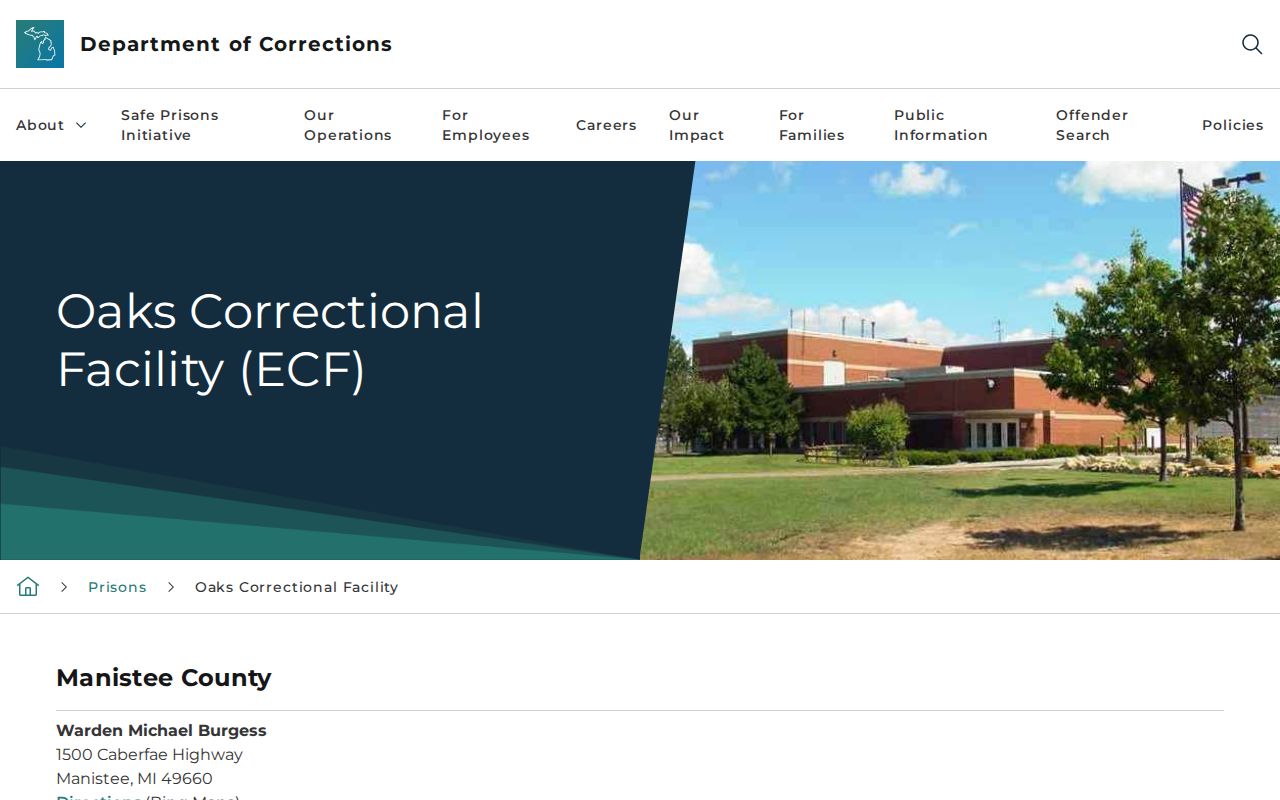
Facility scale does not create a local release list. The county’s 24-hour and 72-hour release pages concern the lack of a verified Sheriff feed, not an Oaks prison roster. Person-level state release research belongs in OTIS and MDOC records. The prison page should be used to confirm the institution’s identity, contact, security levels, history, and published programs.
Two Manistee Release Systems
Manistee County’s correctional landscape makes source labeling vital. Oaks is a 1,108-capacity MDOC prison with Level II and IV housing. The Manistee County Jail is an 82-capacity Sheriff facility built in 1989 and expanded in 2009. Oaks opened in 1992. Although both sit in the same county, their person records do not merge.
Sheriff and court records verify a county jail exit. OTIS and MDOC records verify an Oaks prisoner’s parole, state transfer, or discharge. A local jail booking may never appear in OTIS. Conversely, Manistee Sheriff records are not the correct source for a person serving a state sentence at Oaks. The Manistee County Jail release page covers the county path.
| Question | County jail source | Oaks source |
|---|---|---|
| Is the person still at this facility? | Jail corrections line | OTIS facility and status |
| Why did custody change? | Sheriff movement record and court order | OTIS status and MDOC record |
| Did supervision end? | Court or supervising office | OTIS discharge status or MDOC record |
Oaks Release Readiness Programs
Oaks publishes several programs linked to preparation and behavior change. They include Thinking for Change, violence-prevention work, substance-use education, academic education, and counselor help with vital documents and certifications. START units provide a named alternative-to-segregation structure. These facts add useful context to a state prisoner’s setting.
Program availability does not establish a person’s release date, parole decision, completion, or eligibility. It also does not promise that each participant will receive every listed service. A certificate or document-readiness effort may aid transition, but it is not a Parole Board grant. Keep program facts separate from the legal and administrative proof of release.
- Parole
- Conditional community release from an MDOC prison sentence under Parole Board authority.
- Discharge
- The end of the sentence or the relevant MDOC supervision term.
- Transfer
- Movement to another prison or authority while custody continues.
- Projected date
- A current estimate that can change and is not the same as actual physical release.
Oaks Release Date Limits
Michigan generally uses indeterminate sentences. The judge sets a minimum, while law supplies or permits the maximum. For truth-in-sentencing cases, the prisoner serves 100 percent of the judicial minimum before parole consideration. It is incorrect to apply a broad “85 percent” shortcut. Covered prisoners cannot reduce that minimum with good time or disciplinary credits.
Older offenses may fall under legacy good-time or disciplinary-credit rules. Offense date and legal eligibility matter, not the current calendar alone. Misconduct, consecutive sentences, jail credit, resentencing, appeal, a detainer, parole rescission, or corrected records can also alter the operational date. The Earliest Release Date is an eligibility point, while Maximum Discharge is an outside endpoint. Neither automatically confirms the day a person left Oaks.
For an actual event, read the judgment and offense date, confirm concurrent or consecutive sentence structure, inspect OTIS, check parole status, and then look for Date Paroled or discharge information. If the public fields conflict, seek the underlying MDOC record or contact the office responsible for that field. Court-derived errors go to the sentencing court. Supervision or absconder errors go to the supervising office. Set-aside documentation goes to MDOC Records Administration.