
Manistee Parole and Probation
Parole and probation both permit a person to live in the community under rules, but they begin at different points. Michigan parole is conditional release from an MDOC prison sentence. The Michigan Parole Board is the sole paroling authority for eligible MDOC felony prisoners. Probation is imposed by a judge as a community sentence. Felony probation is administered by MDOC Field Operations, while Manistee District Court Probation is a separate local function. A person can therefore be in Manistee County and report to a different kind of office based on the judgment.
The difference matters when checking a released person. “Parole” in OTIS means the person has left secure state prison custody but has not reached final discharge. “Probation” does not prove the person ever served an MDOC prison term. It may follow a jail stay, or it may be imposed without a prison commitment. “Discharged” generally means the relevant MDOC sentence or supervision has ended. None of those labels proves that every county, federal, or immigration hold has cleared.
| Feature | Parole | Probation |
|---|---|---|
| How it begins | Parole Board grants conditional release from an MDOC prison sentence | Court orders a community sentence |
| Manistee authority | Michigan Parole Board and MDOC Field Operations | MDOC for felony probation or District Court for local probation |
| Best public check | OTIS status, Date Paroled, and supervision location | OTIS for felony probation; the sentencing court for local probation |
| End point | MDOC discharge after parole is completed | Discharge or court completion under the governing order |
- Parole
- Conditional community release from an MDOC prison sentence.
- Probation
- A court-ordered community sentence with stated terms.
- Discharge
- The end of the applicable sentence or supervision.
- Absconder
- A person whom the supervising agency reports as no longer complying with supervision and whose location is not known.
Verify Manistee Post-Release Supervision
Use the record that matches the sentence. For an MDOC parolee or felony probationer, start with the Offender Tracking Information System. OTIS includes current prisoners, parolees, felony probationers, people under Interstate Compact supervision, escapees, absconders, and people within three years after supervision discharge. It excludes people whose only custody was a county jail or city lockup. A missing result is therefore unresolved, not proof that supervision never existed.
- Search by MDOC number when known. Otherwise, use the exact name and compare identity details, conviction county, and offenses.
- Open the full profile. Read the status, Date Paroled, sentence information, and supervision location instead of relying on the result-list label.
- If OTIS says parole or felony probation, use the office shown on that profile. Do not assume the office from conviction county alone.
- For District Court probation, check the sentencing court record and contact Manistee District Court Probation. It is distinct from MDOC supervision.
- Record the system and date checked. If the status appears stale, ask the owning office where an accuracy concern should be sent.
Assignments can change. Interstate cases may also be handled outside the county. The person-specific office in OTIS is more reliable than a general county directory for an active MDOC case. If a court order conflicts with the profile, obtain the signed judgment or amended order and confirm the correction route before drawing a conclusion.
Manistee Parole and Probation Office
Manistee County is part of MDOC Field Operations Region 2. The official Region 2 office directory lists the local state parole and felony-probation office. Call only after checking the individual OTIS profile, because a listed supervision location may point elsewhere. Staff may confirm the displayed office or explain how to route a correction, but private supervision details may be restricted.
415 Third Street
Manistee, MI 49660
231-723-7215
The county also lists District Court Probation at 231-398-3515. Juvenile probation uses a separate number and process. These contacts should not be substituted for one another. The state office handles MDOC parole and felony probation, while the district office handles probation assigned through that court.
The official Region 2 directory shows the Manistee field-office entry used to route state supervision questions.
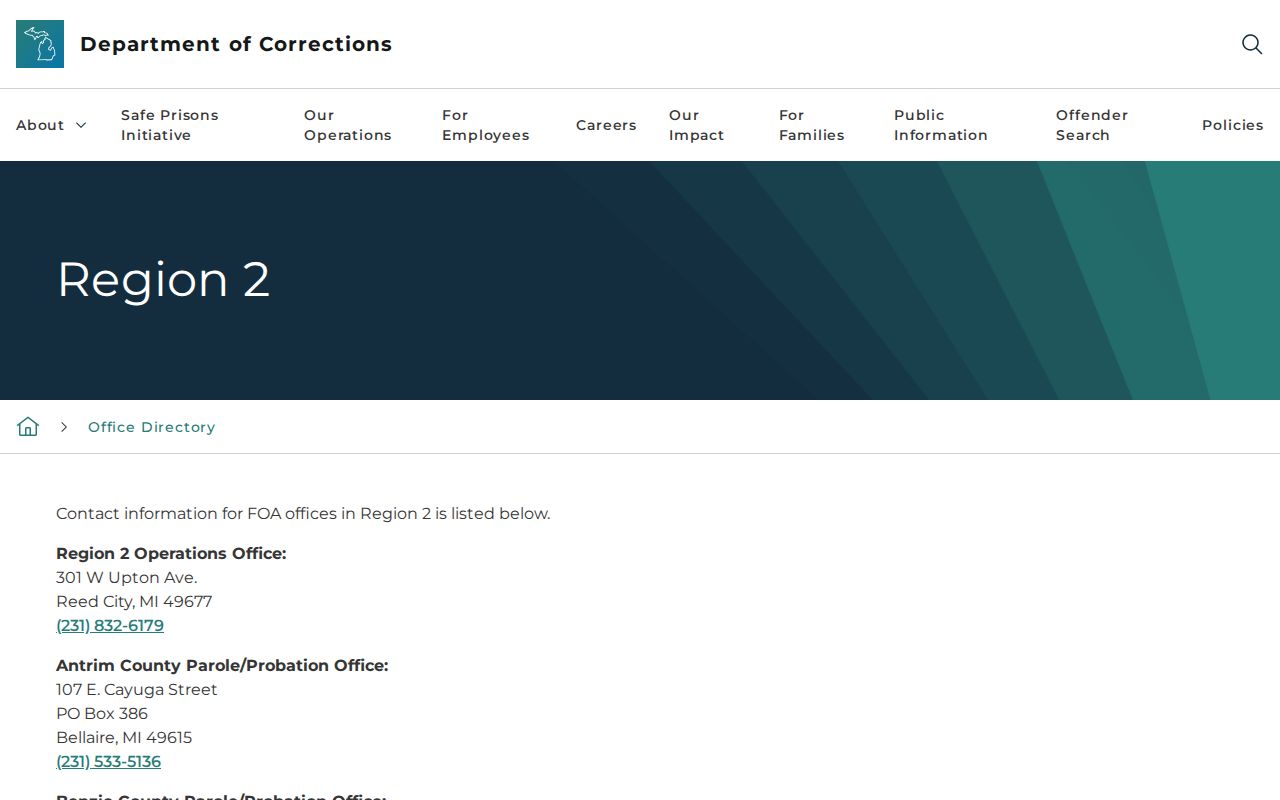
The image identifies the regional channel, but the person’s OTIS profile remains the best source for the current assigned office.
Manistee Supervision and Absconders
Supervision conditions come from the court order, parole order, and agent instructions. They vary by case. A public profile cannot be used to infer every term. The key public distinction is status: active parole or probation shows supervision continues, discharge indicates it ended, and absconder status signals an unresolved failure to remain in contact. An absconder may face a warrant and return to custody. That status is not an unconditional release.
MDOC operates an Absconder/Escapee Tip Line at 517-755-0855. It is for relevant location information, not routine status questions. Ordinary questions belong with the office shown in OTIS. Michigan VINE may transmit a custody change from a participating reporting agency, but it does not replace the supervision record. A VINE release event can mean exit from one facility while parole, a transfer, or another agency’s custody continues.
Parole Board action also has timing limits. Consideration often starts before the eligibility point. A grant moves to the Parole Release Unit, and MDOC describes at least a 28-day interval between the Board’s decision and physical release. A grant date is not necessarily the gate date. Routine consideration is not published through a universal person-level calendar or decisions search.
The public-hearing registration list has a narrower purpose. It covers lifer-law, commutation, and pardon hearings, not routine parole consideration or returned parole violator proceedings. Individual public notices are commonly posted before a listed hearing, and registration is required in advance. A notice proves only that consideration is scheduled. It is not a parole grant, an actual release record, or proof that supervision has ended. MDOC’s legislative archive contains aggregate quarterly Parole Board decision reports, but those totals cannot be converted into a named person’s outcome.
Manistee Supervision Discharge Records
Completion is best confirmed retrospectively. In OTIS, a discharged profile within the public display period documents that MDOC supervision ended. MDOC generally keeps recently discharged profiles visible for three years after the supervision discharge date. That public window is not a full records-retention schedule. For an older former prisoner, MDOC Records Retention or the MDOC FOIA process is the better route.
For local court probation, read the register of actions and obtain the completion or discharge order from the sentencing court when the status matters. The 85th District Court handles misdemeanors and early felony stages, while the 19th Circuit Court records office covers felony disposition. A court record can outlast a temporary online correctional profile. It can also show an amended order, revocation, or later set-aside. A clerk acting in a judicial role is reached through court-access procedures rather than Sheriff FOIA.
A full local release path starts with the Manistee County released-inmate search and record steps. That distinction prevents an MDOC supervision result from being mistaken for the time a person physically left Manistee County Jail.
Note: Preserve the status wording and date checked, because parole, probation, discharge, and custody can change after an online lookup.
Manistee Reentry After Parole
Oaks Correctional Facility offers named programs that can support transition work before release. MDOC identifies Thinking for Change, violence-prevention and substance-use education, academic programs, and counselor help with vital documents and certifications. Those are facility programs, not proof that a specific person completed a course or will receive a given service after parole. Individual eligibility and planning remain case-specific.
Manistee hosted a community re-entry simulation in 2025. Participants moved through stations representing courts, transport, and social services during a simulated month after incarceration. The event showed real transition pressures. It did not establish a permanent intake program or promise services to each released person. Confirm any current resource directly rather than treating the simulation as an enrollment channel.
The official Oaks facility page is the source for its named programming. Program participation does not establish an actual Date Paroled or discharge.
Correct Manistee Supervision Records
Error correction follows the record’s owner. This is the most direct way to avoid a generic support request that reaches the wrong office. If an OTIS field came from the judgment, MDOC directs the person to the sentencing court. Supervision and absconder information should go to the supervising agent or office. Set-aside documentation goes to MDOC Records Administration at 4000 Cooper Street, Jackson, MI 49203; the MDOC FAQ also gives fax 517-335-1844 for a copy that the department can verify with the court.
VINE cannot edit agency data. A wrong VINE custody fact goes to the reporting facility. Michigan Public Sex Offender Registry corrections go to local law enforcement or Michigan State Police, not the parole office. Each system owns only its record. Correcting one source does not automatically revise the others.